Who Has Everyone's Number?
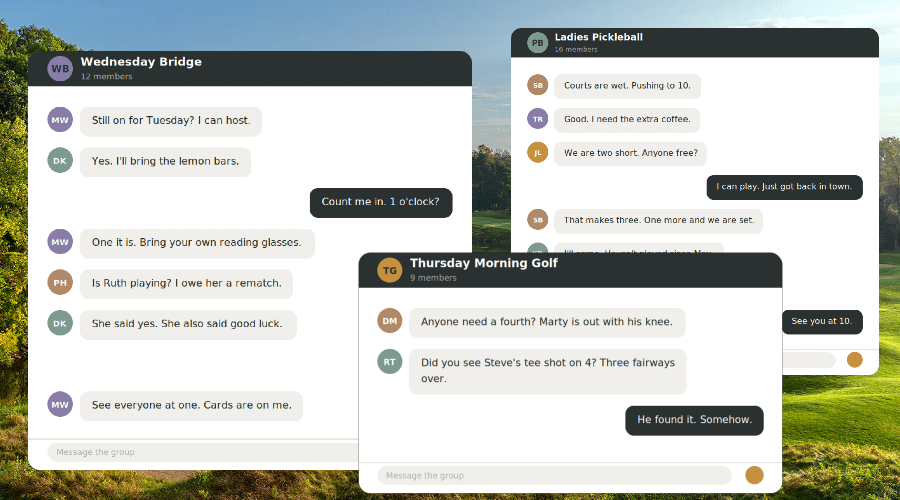
A member decides to start a Thursday morning golf group. Eight or nine players, same tee time each week, nothing formal. The signups are handled, the reminders go out, and everyone knows when to show up.
Then someone says the obvious thing. We should have a group text.
And they should. Not for the logistics, because those are already sorted. For everything else. Who needs a fourth this week. Whether anyone has seen Bill since his knee surgery. What happened on seventeen. Whether the range is open before eight. The part of a group that is actually the group.
So someone starts a thread. And to start it, they need everyone's number.
The first cost is a phone number
This sounds like nothing until you are the member being asked.
You joined a card game six weeks ago. You know two people in it well and the rest by face. Now you are being asked to hand your mobile number to thirty people, most of whom you could not pick out of a lineup, and to accept theirs in return.
Most members do it, because the alternative is being left out. But it is a real cost, and it lands hardest on exactly the people a club most wants to bring in. The new member who joined in March and does not know anyone yet. The member who is careful about their privacy. The member whose late spouse used to handle things like this and who is not sure how to add thirty contacts to a phone.
None of them will say any of this out loud. They will just end up slightly outside the group.
The second cost is that there is no roster
A group text has no membership list. It has whoever happened to be in the room when it started, plus whoever somebody remembered to add later.
That means adding a new member requires two things. Someone has to have their phone number, and someone has to think of it. If the group's organizer is the one who collected all the numbers in the first place, it usually falls to them by default. And when they are not around, it often does not happen at all.
The member who started the thread moves south. Or gets sick. Or resigns. Nobody removes them, because nobody removes anyone. The new member who joined in October never gets added, because the person who would have thought of it is gone. What existed for nine years as the social center of a group slowly stops matching the group.
It gets worse if anyone in the thread is on Android. A mixed group falls back to standard texting, and in that case nobody can add anyone at all. The only way to include a new member is to start the whole thread over.
The group is still on the books. The activity still shows up wherever the club tracks it. What went missing is invisible.
The third cost is what happens when someone tries to solve it
A personal example, from a different world but it highlights the same problem.
My daughter plays club volleyball. The club uses an app that handles schedules and rosters, and it has a team chat built in. The club asks that all team communication happen there. I assume the reason is oversight, and honestly it is a defensible one. These are kids, and somebody should be able to see how the adults are talking to each other and about each other.
Some of the parents started a separate chat on a different app anyway. There was a brief discussion about whether that broke the club's rule. It did, and nobody minded much because the assumption was that everything in the club's app could be read by the club. Other teams did the same.
Here is what actually happened next. The same topics ran in both places. Sometimes deliberately, because the conversation the parents wanted to have was one they did not want the coaches reading. Sometimes just because someone opened the wrong app first.
I missed things constantly. A thread would develop in one place while I was looking at the other. I would answer a question that had already been answered somewhere I had not checked. Worse, I would ask a question that had already been asked and answered. Very embarrassing. I was not being excluded from anything on purpose. I was just always slightly behind, in one of two conversations that were both real. And often I was not able to find conversations that the team mom specifically tagged me in. Having group chats spread across multiple apps and texts was a personal nightmare. Many parents told me they had the same experience.
Nobody in that situation did anything wrong. The club had a reasonable instinct. The parents had a reasonable instinct. What it produced was multiple systems with overlapping responsibilities, and a group of people who were all slightly out of sync with each other.
That is the outcome any club should expect from telling members where to talk. And it is worth noticing where it came from. The second channel existed because the first one was being watched.
What changes when the conversation belongs to the group
We added chat to GroupValet this week, and it works the way the rest of a group works. It belongs to the group rather than to a phone.
Members of a group can message each other inside GroupValet. One to one. A few people at once. Or everyone in the group. Any member can message the whole group, not only the organizer, which matters more than it sounds, because it means the conversation does not depend on one person being present.
Nobody exchanges a phone number. Everyone in the group is already there, and members can only message people in a group they both belong to.
When somebody new joins the group, they are automatically in the conversation. Nobody has to have their number, and nobody has to remember to add them. And when a member leaves the club, they are out of it, without anyone having to handle that either.
A few things worth knowing
It is private. Nobody at the club can read members' messages. Neither can anyone at GroupValet. That is not only a courtesy to members. It is the reason a second channel does not need to exist.
It is off until you turn it on. Chat is disabled by default. A club enables it, which only gives groups the option, and then each group manager decides whether to use it. Groups that do not switch it on carry on exactly as before. Nothing appears in front of your members without those two deliberate decisions.
Members control their own experience. Anyone can block another member, mute a conversation so it stops notifying them, or leave a group conversation.
A group text gives you less. You can silence notifications, but you cannot block one person and stay in the conversation. Apple's own guidance for blocking a group is to leave it instead. And if anyone in the thread is on Android, you cannot leave either. The advice at that point is to mute the whole thing and hope you do not miss anything that matters.
It works wherever members already are. The website or the app, and messages arrive either way.
The part that is easy to miss
None of this is about the club watching what members say. The club cannot see any of it, and I would argue should not want to.
It is about where the conversation lives. Right now, at most clubs, it lives on the personal phone of whichever member volunteered first, or in other outside apps. That has worked for years, and it will keep working right up until the moment it does not.
Every group has two halves. The logistics, which is the calendar and the signups and the roster, and the conversation, which is everything the group actually says to each other. At most clubs those two things live in completely different places, and nobody planned it that way. It happened because the tools were separate. They do not have to be.
Frequently asked questions
Can club staff read members' chat messages?
No. Conversations between members are private. Nobody at the club and nobody at GroupValet can read them. Clubs should set that expectation clearly with members when enabling the feature.
Do members have to share phone numbers to use chat?
No. Members of a group can message each other without exchanging any contact information. A member can only message people who belong to a group they are also in.
How do clubs turn on chat for member groups?
There are two steps. The club enables chat for the community, which gives groups the option without starting anything. Then each group manager decides whether to switch it on for their group. Groups whose managers do not enable it continue as before.
What happens to a group's messages if the organizer leaves the club?
The conversation belongs to the group rather than to a set of phones or any individual, so it continues. A group text has no membership list, which means adding someone requires having their number and remembering to do it, and in a mixed iPhone and Android group nobody can add anyone at all without starting over.


